
Renewable Energy in Ukraine
 +380 (66) 508-07-64
Galvanic corrosion is the result of an electrochemical reaction. For galvanic corrosion to take place, four things must exist simultaneously: an anode, a cathode, an electrolyte and a conductive path between two pieces of metal. A galvanic circuit is created in which the anode loses electrons to the cathode with the assistance of the electrolyte. The galvanic cell created by two dissimilar metals and the presence of the electrolyte operates only in one direction. Consequently, the anode eventually disintegrates.
In PV installations, the anode and cathode consist of metals, such as stainless steel, copper and aluminum. Water commonly serves as the electrolyte. Whether galvanic corrosion is a serious problem depends on the potential failure point. For a PV installation, the long-term effects of corrosion can range from unsightly finishes to racking or fastener failure.
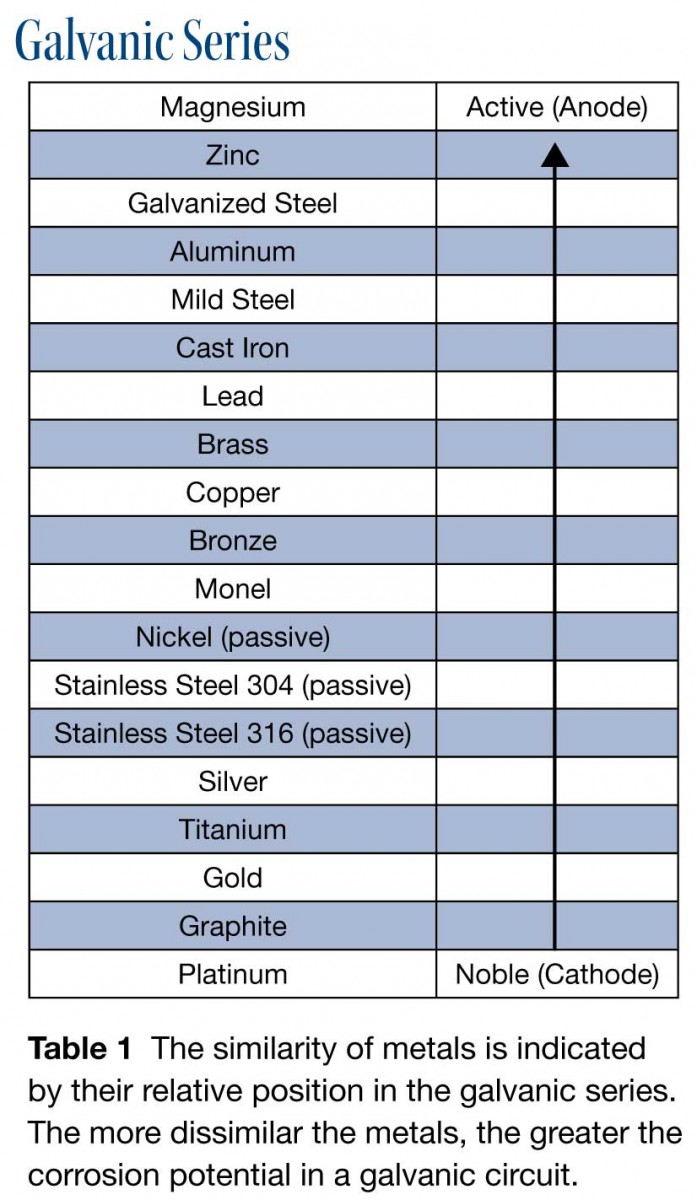
The more dissimilar the metals, as reflected by their relative position in the galvanic series, the greater the corrosion potential in the galvanic circuit. The general rule is to avoid joining metals far apart in the galvanic series. For example, steel is anodic next to brass, and stainless steel is cathodic next to zinc or aluminum. Another way to read this is that steel corrodes next to brass and stainless steel, while aluminum and zinc corrode next to steel when an electrolyte and a conductive path are present.
Every metal has a standard electrical potential (voltage) based on its ability to release or accept electrons when in contact with a dissimilar metal and an electrolyte. In reality, the galvanic system is more dynamic than most published material on voltage-potential data suggests. The actual reaction that takes place between two metals in the environment is dependent on electrolyte concentration, pH, temperature and other factors. Rob Haddock from Metal Roof Innovations, manufacturer of the S-5! mounting clamp, provides a word of caution about using the galvanic scale. «Some installers might want to use the galvanic scale to identify dissimilar metals, but the graphical galvanic scale is not always a good way to determine whether one metal is compatible with another,» he says. «When metals oxidize, the oxide layer created is a new material that may or may not exhibit the electrochemical characteristics of the parent material.»
More detailed information is currently available in Ukrainian language.
Read more:
Methods for determining the soiling assessment of solar PV arrays
Solar panels, especially those mounted on fixed structures, practically do not require complex maintenance. However, electricity generation can be significantly reduced due to surface contamination of solar panels. This article will be devoted to the study of this issue.
The Solar Energy Market Players Statement
On November 19, Avenstone CEO Dmytro Lukomskyi participated in a press conference of the Solar Energy Association of Ukraine on the position of industry players in the context of the latest proposals of the Ministry of energy and environment protection of Ukraine.
FIT in Ukraine
Green tariff was officially entered in Ukraine in 2009. The main obligation of the state was to buy back all amount of electric power, generated with the use of renewable energy sources (RES)
Denmark provide $19 million to hydrogen production
The Danish government has announced the development of two renewables-powered energy storage projects, GreenLab P2X and HySynergy. The stored energy will be used as a fuel for buses, aircraft, and ships.